
'/%3e%3cdefs%3e%3clinearGradient%20id='prefix__paint0_linear_4737_37157'%20x1='3.018'%20y1='23.6'%20x2='44.925'%20y2='24.977'%20gradientUnits='userSpaceOnUse'%3e%3cstop%20stop-color='%231CB7FF'/%3e%3cstop%20offset='.502'%20stop-color='%232FF58B'/%3e%3c/linearGradient%3e%3c/defs%3e%3c/svg%3e)


Mythbusting Messi: England must beware 'walking ghost' who gets better against top opposition
Jul 15 2026 08:48 · By Morgan King,and,Fergus Sowrey, Machine Football · 14 Reads


You've heard it before -
Lionel Messi
spends most of any given football match at a walking pace.
Not that he tends to slow down the tempo, or that he spends too much time on the ball, but that he literally walks around the pitch whenever he isn't on the ball.
There's an illuminating Opta stat being shared on social media that there's only been two instances a forward has covered 5km walking in a match at the 2026 World Cup. It was Messi both times - 5.2km against Cape Verde and 5.3km against Switzerland.
Messi's ability to unnerve defenders with his lurking, ghost-like presence only creates more uncertainty for his team-mates to exploit, all while he's scanning the pitch for the space to make his next move to devastating effect.
“It is just incredible, how he pulls it out every single time, in so many different ways,' Thomas Tuchel told reporters on the eve of England v Argentina on Wednesday.
“He finds spaces, he finds moments, and I think the big thing is the whole team buys into that idea.”
Messi is still capable of deciding games at 39, but he doesn't always do it in the same way.
In fact, across this
World Cup
and
Argentina
's qualifying campaign, two different versions of Messi do emerge. Against weaker opponents, he dominates matches, constantly arriving in dangerous areas and creating chances almost at will.
Against stronger sides, he becomes more selective. Fewer touches. Fewer chances created. The numbers drop - but rather than his efficiency waning, the moments simply become more decisive.
Machine Football
analysed every one of Messi's World Cup and World Cup qualifying appearances since October 2023 to find out whether the numbers support that impression.
Across 17 Argentina appearances over the last three years, Messi's output has changed dramatically depending on the calibre of the opposition.
Against
Brazil
,
Uruguay
Colombia
Switzerland
Austria
, all teams in the top 25 of FIFA's
world
rankings, he averaged 0.54 goal contributions per 90 minutes.
Against Chile, Peru,
Paraguay
, Bolivia, Venezuela,
Egypt
Algeria
Jordan
Cape Verde
- all outside the top 25 - that figure almost triples to 1.50.
The supporting numbers tell the same story: expected goals rise from 0.52 to 0.67 per 90, key passes almost triple from 0.36 to 1.06, and touches inside the penalty area climb from 2.00 to 3.34.
Against weaker opponents, Messi simply becomes involved far more often. He spends longer around the penalty area, creates more chances and carries a greater share of Argentina's attacking burden.
In one sense, then, Messi's involvement does indeed fade against higher-class opposition.
The interesting part, though, is not the volume of Messi's actions but their quality. Despite producing fewer goals and creating fewer chances against stronger opponents, Messi actually becomes more efficient whenever he chooses to act.
His dribble success rate rises from 75.0% against lower-calibre opposition to a scarcely-credible 88.9% against stronger teams. His duel success also improves, increasing from 50.0% to 54.8%.
That suggests elite opponents are not stopping Messi. They are merely forcing him to become more selective. Rather than attempting to dominate every attack, he waits for moments where success is most likely.
This ability to smell opportunity is something Messi does better than anyone, to the extent it's as if he has a sixth sense. It is what has allowed him to remain deadly against any opposition despite being years past his own physical peak.
Fewer actions, but better ones - work smarter, not harder, if you like.
View 3 Images
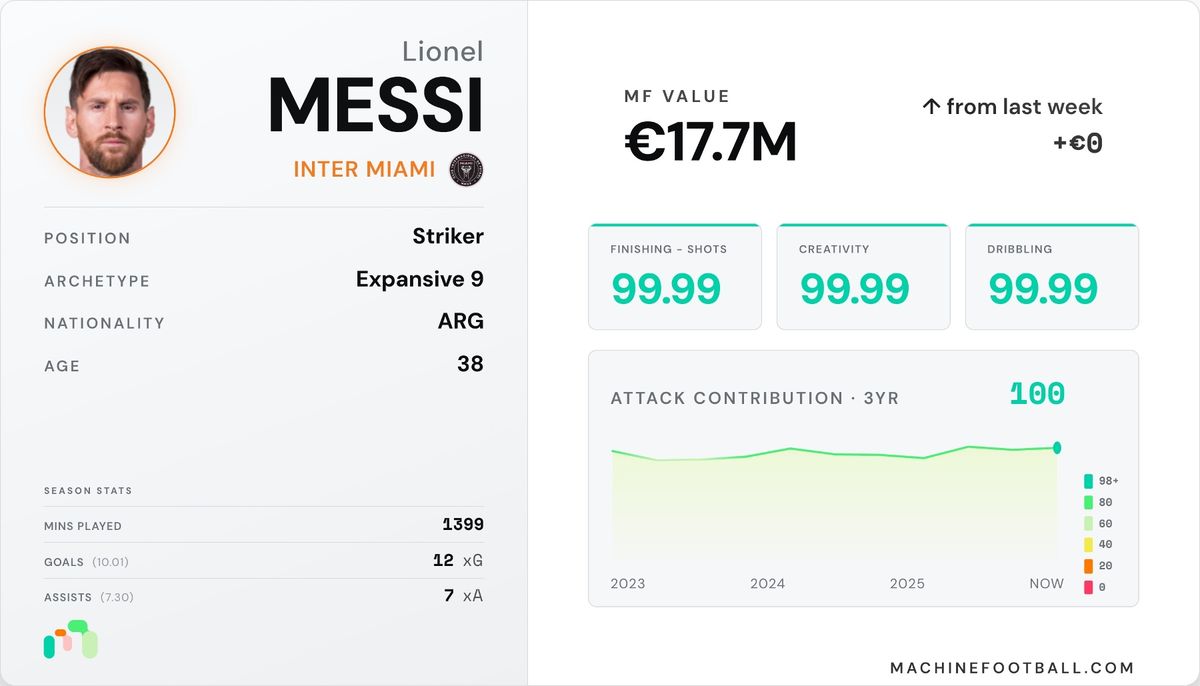
This will be the first time Tuchel has managed against Messi, and he says Argentina's strength is the "family" approach of 10 team-mates "ready to give everything for Leo Messi".
“Even if they are key players, big players in this club, it's just how it is. They thrive from that. This is totally normal for them and makes them very, very strong.
“They buy into the idea to support Messi, to help him, and they're just ready when he bursts into action to make the difference.
“We will prepare for that of course. Can you prepare for that and find a recipe and focus too much on him? No.
“We need to be brave around him and we need to stop the support, and we need to take care of all the movements that happen when he's on the ball. We're totally aware that they cannot stop him all the time and for one hundred percent."
The distinction matters ahead of
England
's World Cup semi-final. England are, on the basis of their own talents, unlikely to face the version of Messi that records three or four key passes and lives inside the opposition penalty area.
History suggests they are more likely to encounter the patient version. The one who dribbles less often, but completes almost every attempt; the one who creates fewer chances overall, but still averages 0.52 expected goals per 90 against elite opposition.
England cannot judge Messi's threat by how often he touches the ball. Against stronger teams, he simply needs fewer moments to change a game.
Against England, he could look to keep the inverting Nico O'Reilly in central areas when off the ball - opening up space on the right for the overlapping runs of Nahuel Molina - or to pull
Marc Guehi
out of his shape to make space in behind for Alvarez.
Put simply, there's plenty he can be doing to hurt England even when moving at a low speed - and even without the ball at his feet.
There is, naturally, a caveat: five matches against higher-calibre opposition is not an enormous sample, and one exceptional performance - such as his haul of five goal contributions against Bolivia in October 2024 - could move several of the underlying numbers.
The split between opponents is also based on current FIFA world rankings, which doesn't necessarily tell the full story - Venezuela, for example, fall into the lower-calibre group despite an encouraging qualifying campaign.
Messi, after all, is nothing if not adaptable, and envisioning his game as two modes - one for the best teams, one for the rest - is an intentional simplification.
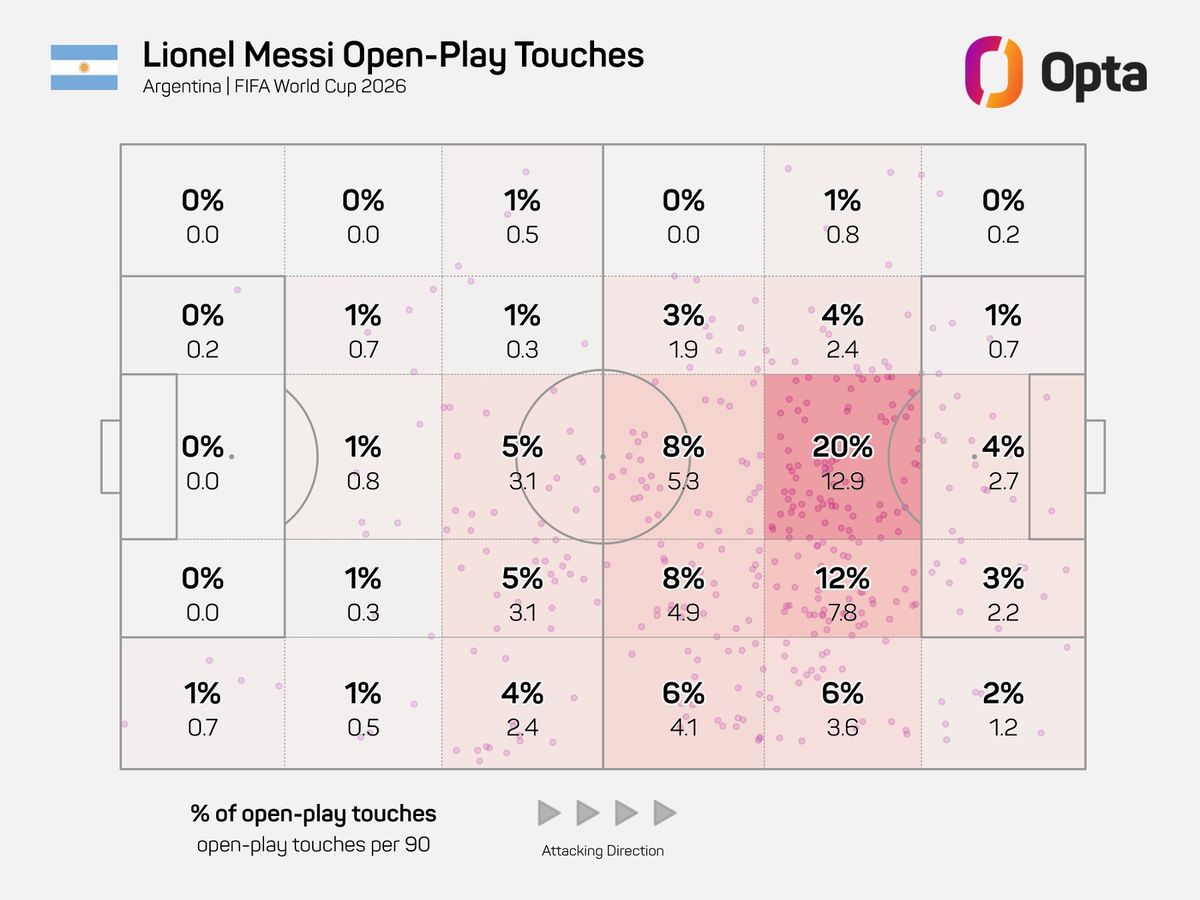
Some elements of his game stay fairly consistent. Over the course of the tournament, Messi's touch map shows a clear preference for central areas and the right half-space, doing most of his work between the central and final third - no longer popping up absolutely everywhere on the field, but still more than happy to drop deeper or even drift into the left half-space to find pockets to operate in.
Conversely, he can be expected to step up his intensity if the game requires it - Messi registered six sprints over 120 minutes against Switzerland, double his next closest tally at the tournament - but overall he has still covered less distance per 90 than any other Argentina outfield player while his average sprints per 90 at this World Cup is 2.7, lower than any England outfielder bar
John Stones
.
Even allowing for these caveats, though, the pattern is remarkably consistent: the production changes, the efficiency does not.
In the build-up to England's 2-1 quarter-final victory, all the focus was on their star player
Erling Haaland
, and Tuchel said: "Messi is a very different player than Erling Haaland, but we did very, very well in our way, in the way you maybe should play against Erling. We will find a way now.”
Against stronger opponents, Messi simply needs fewer moments to decide a match.
That may be the most important lesson for England as they prepare to face Argentina.
Content cannot be displayed without consent