
'/%3e%3cdefs%3e%3clinearGradient%20id='prefix__paint0_linear_4737_37157'%20x1='3.018'%20y1='23.6'%20x2='44.925'%20y2='24.977'%20gradientUnits='userSpaceOnUse'%3e%3cstop%20stop-color='%231CB7FF'/%3e%3cstop%20offset='.502'%20stop-color='%232FF58B'/%3e%3c/linearGradient%3e%3c/defs%3e%3c/svg%3e)


The reasons why the United States could host another World Cup sooner than you think
Jul 25 2026 00:47 · By ANGEL NAKAMURA · 276 Reads


FIFA's confederation rotation system could give America another international tournament
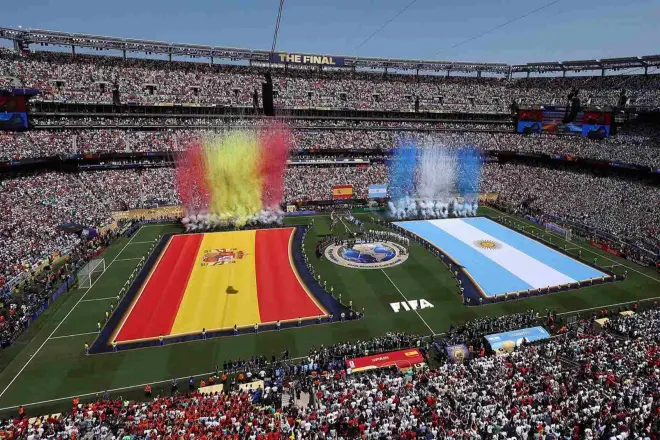
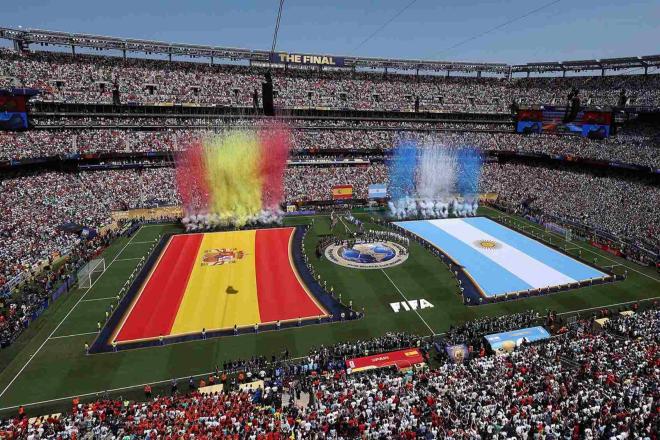
The 2026 World Cup may have just concluded on American soil, but the United States could already be positioning itself for another run at hosting soccer's biggest tournament. That possibility may surprise fans, especially after the mixed reactions surrounding the 2026 event.
Even though many praised the country's stadiums, attendance, and infrastructure, some critics argued that FIFA should take the tournament elsewhere before returning to North America. Despite those sentiments, a combination of FIFA's hosting rules, comments from government officials, and uncertainty surrounding rival bids has suddenly made an American bid for the 2038 World Cup look far more realistic than many expected.
FIFA's rotation policy keeps the door open
At first glance, it would seem almost impossible for the United States to host consecutive World Cups only 12 years apart. However, FIFA's confederation rotation system tells a different story. The 2030 tournament will be centered in Europe and Africa, with Royal Spanish Football Federation's Spain, Portugal, and Morocco serving as the primary hosts while Argentina, Paraguay, and Uruguay each stage a centenary opening match.
Four years later, Saudi Arabia will host the 2034 World Cup. Because of FIFA's continental rotation policy, nations from North America and Oceania are eligible to submit bids for the 2038 tournament, meaning the United States is not automatically excluded despite having co-hosted the 2026 edition.
The White House is already thinking ahead
The possibility of another American World Cup isn't just speculation. Last month, Andrew Giuliani, executive director of the White House's World Cup Task Force, openly discussed the idea of another United States bid. "When you think that this World Cup may at some point expand out to 64 teams, I think the United States can handle it," Giuliani said.
He added that officials wanted to focus on finishing the 2026 tournament before making a pitch for "2038 or other ones." Those comments suggest discussions about another American bid may already be underway, even if no formal proposal has been submitted.
A 64-team tournament could favor America
One of the biggest reasons the United States could become an attractive host again is infrastructure. If FIFA eventually expands the men's World Cup from 48 to 64 teams, as some officials have discussed, very few countries possess enough large-capacity stadiums, hotels, airports, and transportation networks to accommodate such an event.
The United States has already demonstrated that it can successfully organize major international competitions across multiple metropolitan areas. The country also benefits from NFL stadiums capable of seating more than 70,000 spectators, extensive domestic air travel, and an established hospitality industry. Those advantages become even more valuable if the tournament grows larger.
Australia may wait until 2050
Another factor strengthening the United States' position is the apparent absence of one of its biggest potential competitors. Australia had frequently been mentioned as a possible candidate for the 2038 World Cup. Instead, the country's current government has shifted its attention toward hosting the 2050 men's tournament.
Officials believe Australia will already have world-class sporting infrastructure in place following the 2027 Rugby World Cup and the 2032 Brisbane Olympics. Australia also successfully co-hosted the 2023 FIFA Women's World Cup alongside New Zealand.
If Australia delays its ambitions until 2050, the number of serious contenders for 2038 could shrink considerably. The idea of another World Cup in the United States has also received support from Donald Trump. Speaking before attending the 2026 World Cup Final, Trump revealed that he had encouraged FIFA president Gianni Infantino to bring the tournament back.
"I had a great idea for Gianni: You have to do two countries. Announce us again next time, and then announce another country after that. It'll take out some of the anger and the shock," Trump said. "Based on the numbers, we will be requesting it again immediately." His comments do not represent an official FIFA process, but they demonstrate that another bid enjoys support from the highest levels of the federal government.